HOME PRODUCT QUALITY ASSURANCE COA&MSDS ABOUT US CONTACT US CAREER NEWS


Welcome to Solution Resources Corporation>>>>Titanium


MATERIAL SAFETY DATA SHEET

Section 1.  Product General Information And Company Identification

Product Name

Titanium, Sheet, rod, wire, tubing & other mill shapes

UN Number

Not applicable

CAS #

 7440-32-6

WHMIS Classification

This is not a controlled product

Chemical Formula

Ti

Product Use

Thin films,Glass,optical intruments etc.

Available Packaging

Packed in synthetic case

Responsible Party

Solution Resources Corporation (SRC)
Rm706,East Star Building,1508 Jiangpu Rd. Shanghai China
Post Code:200092
For further information,please contact SRC MSDS coordinator
at +86 13817363982
Working time:9:00am-17:00pm , Monday-Friday


Section 2. Hazardous Ingredients

Hazardous Component  % 

OSHA/PEL             ACGIH/TLV            Sec. 302              Sec. 304            Sec. 313

Titanium      0-100 

N/E                       N/E                           No                        No                       No

Titanium Powder  0-100

15 mg/m3              10 mg/m3                 No                           No                   No

HMIS Ratings (Solid):

Health: 1           Flammability: 0               Reactivity: 0

HMIS Ratings (Powder):

Health: 1           Flammability: 4               Reactivity: 1

HMIS Protective Equipment:

F: glasses, gloves, apron, dust mask.


Section 3        PHYSICAL DATA


Boiling Point: 

3,287 oC

Melting Point:   

1,668 oC

Vapor Pressure

Essentially 0

Vapor Density

N/A

% Volatiles by Weight: 

0

Solubility in H2O:

Insoluble

Appearance and Odor:

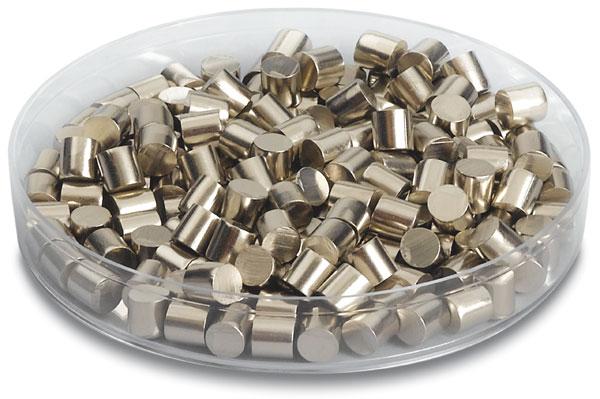
Dark grey powder or silver-grey metal, no odor

Specific Gravity (H2O = 1):

4.507


Section 4  FIRE AND EXPLOSION HAZARDS DATA

Flash Point (Method used):

460 oC for -100 mesh

Flammable Limits:

Upper: N/A  Lower: N/A

Autoignition Temperature:

1200 oC for solid metal in air, 480 oC for very fine particles in cloud form.

Extinguishing Media:

Flammable solid in powdered form . If involved in fire, do not use water, carbon dioxide or halogenated extinguishers. Use dry chemical extinguishing agents, dry sand or dry ground dolomite

Special Fire Fighting
Procedures:

Fire may reignite after having been extinguished. Use normal firefighting procedures which include wearing NIOSH/MSHA approved self-contained breathing apparatus, flame and chemical resistant clothing; hats, boots and gloves. If without risk, remove material from fire area

Unusual Fire and Explosion Hazards:

May burn in an atmosphere of carbon dioxide, nitrogen or air. May react violently with BrF3, CuO, PbO, (Ni + KClO3), metal oxosalts, halocarbons, halogens, CO2 metal carbonates, Al water, AgF, O2, nitryl fluoride, HNO3, KClO3, KMnO4, steam at 704 oF, trichloroethylene, trichlorotri-fluoroethane. Titanium, in the absence of moisture, burns slowly, but evolves much heat


Section 5.   HEALTH HAZARD INFORMATION

Effects of Exposure:

Titanium is generally considered to be physiologically inert. There are no reported cases in the literature where titanium as such has caused human intoxication. The dusts of titanium or most titanium compounds such as titanium oxide may be placed in the nuisance category.

Acute Effects:

Inhalation:

Prolonged inhalation may cause mild irritation to the lungs and respiratory tract.

Ingestion:

Relatively non-toxic, poorly absorbed from the alimentary tract.

Skin

May cause abrasive irritation.

Eyes

Dust or powder may cause irritation

Chronic Effects

None known

Medical Conditions Generally Aggravated by Exposure:

Any preexisting respiratory problems.

?Target Organs:

Mucous membranes

Routes of Entry:

Inhalation, ingestion, skin, eyes.

Carcinogenicity:

NTP: No           IARC: No          OSHA: No         EPA: No

Other:

Questionable carcinogen with experimental tumorigenic data. Experimental reproductive effects.

EMERGENCY AND FIRST AID PROCEDURES:

INHALATION:

Remove from exposure, restore and/or support breathing as needed. Seek immediate medical attention.

INGESTION

Call poison control center. Never give anything by mouth to someone who is unconscious or convulsing. A professional decision about whether or not to induce vomiting is required. Seek medical attention.

SKIN

Wash thoroughly with soap and water. Remove and properly dispose or launder contaminated clothing before wearing it again. Clean material from shoes and equipment. Seek medical attention if symptoms persist.

EYE

Immediately flush eyes, including under eyelids, with large amounts of water for at least 15 minutes. Call a physician.


 Section 6.    REACTIVITY DATA


Stability:

Stable

Conditions to Avoid:

Heat, flame, other sources of ignition, moisture. Massive titanium is stable at ordinary temperatures. Titanium is ignitable and may explode if in a finely divided form.

Incompatibility (Material to Avoid):

Air, aluminum, bromine trifluoride, carbon black, carbon dioxide, metal carbonates, nitrogen, halocarbons, halogens, metal oxides, metal oxosalts, nitric acid, nitryl fluoride, oxidants, oxygen, silver fluoride, steam, acids.

Hazardous Decomposition Products:

Titanium oxides.

Hazardous Polymerization:

Will not occur

Other:

Titanium metal can burn in an atmosphere of carbon dioxide, nitrogen or air. Water applied to hot titanium may evolve hydrogen, causing an explosion.


Section 7.   SPILL OR LEAK PROCEDURES


Steps to be Taken in Case Material is Released or Spilled:

For powder spills: wearing full protective equipment, remove all sources of ignition. Do not use compressed air to clean spill. Use non-sparking tools to clean up. Do not push powder long distances across the floor. Keep in small piles away from each other. Place collected material into non-sparking or anti-static containers (the use of plastic bags is not recommended), due to potential for static electricity buildup inside plastic bags). Label containers with proper identification as ¡®Flammable Solid¡¯.

Waste Disposal Method:

In accordance with Local, State and Federal waste disposal regulations.


Section 8.    SPECIAL PROTECTION INFORMATION


Respiratory Protection:

NIOSH approved dust respirator when exposures are expected to be dusty or exceed the prescribed limits in Sec. II (on page 1). Follow the respirator requirements in 29 CFR 1910.134.

Ventilation:

Use process enclosures, local exhaust ventilation or other engineering controls to control airborne levels below recommended exposure limits. Handle in a controlled environment. Handle in an inert gas such as argon.

Protective Gloves:

Rubber gloves

Eye Protection:

Safety glasses with side shields, or goggles when potential exposure exists.

Other Protective Clothing or Equipment:

Lab coat and apron, flame and chemical resistant coveralls, eyewash capable of sustained flushing, safety drench shower and hygienic facilities for washing

Section 9.    SPECIAL PRECAUTIONS


Precautions to Be Taken in Handling and Storage

Mixing, blending, milling or grinding of dry powder should be performed only under argon or helium. Keep powder away from open flames and other sources of ignition. Try to maintain humidity above 50% to prevent electrostatic buildup. Maintain a supply of ¡®coarse¡¯ (rock type) salt and/or ¡®Class D¡¯ (FOR METAL FIRES) fire extinguisher located near processing and storage areas. No smoking in area. Use non-sparking metal tools and equipment. Keep work areas clean and free of waste. Keep container tightly closed. Store in a cool, dry, well-ventilated area. Wash thoroughly after use.

Other Precautions:

Contact lenses may pose a hazard; soft lenses may absorb irritants and concentrate them. Practice good personal hygiene. Avoid transfer of material from hands to mouth while eating, drinking or smoking.


Issued by:   Jack Liu
Issue Date:  November 1999


»¦ICP±¸05059626ºÅ Copyright@2008 Solution Resources Corporation.All rights reserved